package font
Import Path
golang.org/x/image/font (on go.dev)
Dependency Relation
imports 5 packages, and imported by 2 packages
Involved Source Files
Package font defines an interface for font faces, for drawing text on an
image.
Other packages provide font face implementations. For example, a truetype
package would provide one based on .ttf font files.
Package-Level Type Names (total 7)
Drawer draws text on a destination image.
A Drawer is not safe for concurrent use by multiple goroutines, since its
Face is not.
Dot is the baseline location to draw the next glyph. The majority of the
affected pixels will be above and to the right of the dot, but some may
be below or to the left. For example, drawing a 'j' in an italic face
may affect pixels below and to the left of the dot.
Dst is the destination image.
Face provides the glyph mask images.
Src is the source image.
BoundBytes returns the bounding box of s, drawn at the drawer dot, as well as
the advance.
It is equivalent to BoundBytes(string(s)) but may be more efficient.
BoundString returns the bounding box of s, drawn at the drawer dot, as well
as the advance.
DrawBytes draws s at the dot and advances the dot's location.
It is equivalent to DrawString(string(s)) but may be more efficient.
DrawString draws s at the dot and advances the dot's location.
MeasureBytes returns how far dot would advance by drawing s.
It is equivalent to MeasureString(string(s)) but may be more efficient.
MeasureString returns how far dot would advance by drawing s.
Face is a font face. Its glyphs are often derived from a font file, such as
"Comic_Sans_MS.ttf", but a face has a specific size, style, weight and
hinting. For example, the 12pt and 18pt versions of Comic Sans are two
different faces, even if derived from the same font file.
A Face is not safe for concurrent use by multiple goroutines, as its methods
may re-use implementation-specific caches and mask image buffers.
To create a Face, look to other packages that implement specific font file
formats.
( Face) Close() error
Glyph returns the draw.DrawMask parameters (dr, mask, maskp) to draw r's
glyph at the sub-pixel destination location dot, and that glyph's
advance width.
It returns !ok if the face does not contain a glyph for r. This includes
returning !ok for a fallback glyph (such as substituting a U+FFFD glyph
or OpenType's .notdef glyph), in which case the other return values may
still be non-zero.
The contents of the mask image returned by one Glyph call may change
after the next Glyph call. Callers that want to cache the mask must make
a copy.
GlyphAdvance returns the advance width of r's glyph.
It returns !ok if the face does not contain a glyph for r. This includes
returning !ok for a fallback glyph (such as substituting a U+FFFD glyph
or OpenType's .notdef glyph), in which case the other return values may
still be non-zero.
GlyphBounds returns the bounding box of r's glyph, drawn at a dot equal
to the origin, and that glyph's advance width.
It returns !ok if the face does not contain a glyph for r. This includes
returning !ok for a fallback glyph (such as substituting a U+FFFD glyph
or OpenType's .notdef glyph), in which case the other return values may
still be non-zero.
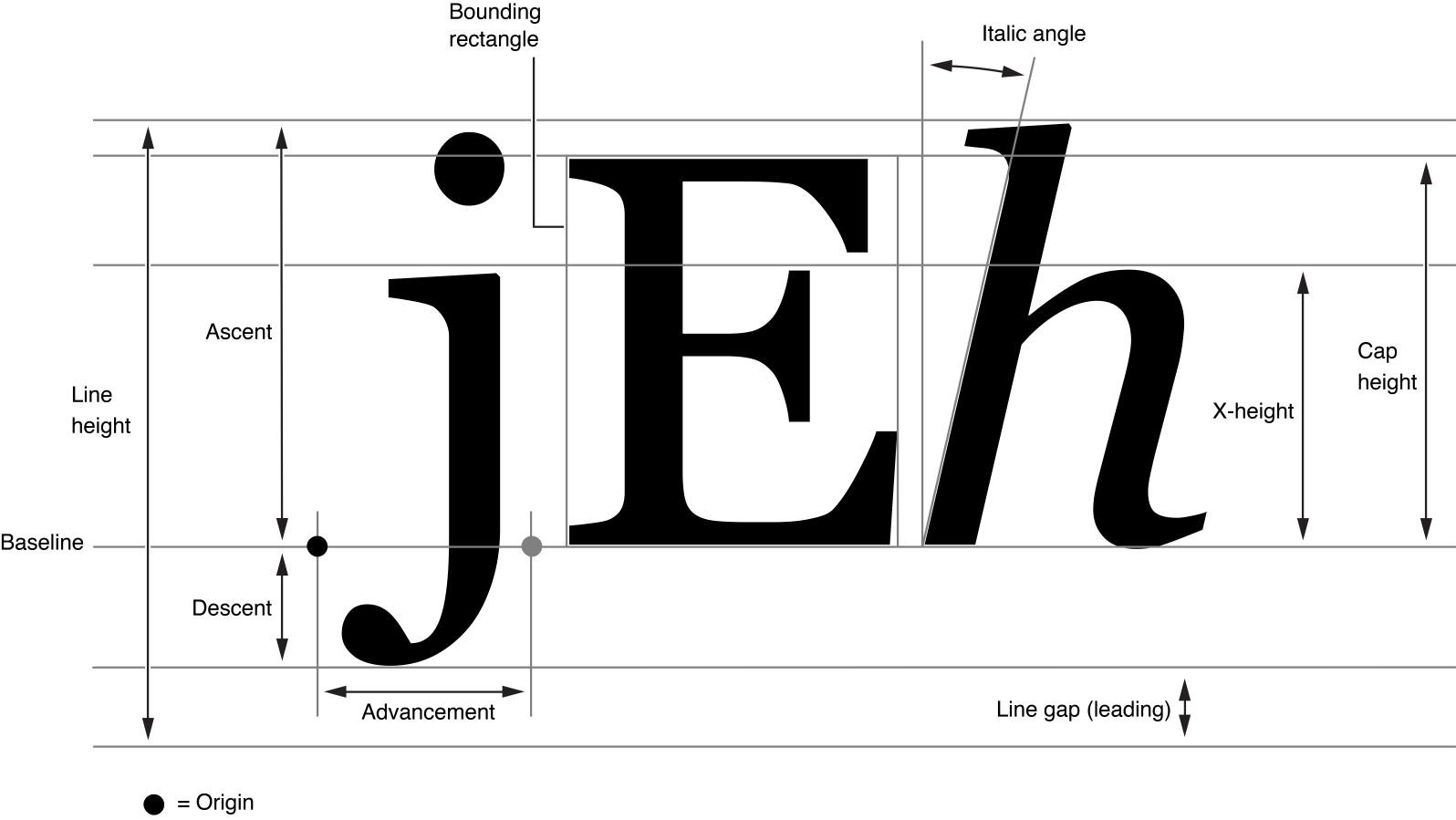
The glyph's ascent and descent are equal to -bounds.Min.Y and
+bounds.Max.Y. The glyph's left-side and right-side bearings are equal
to bounds.Min.X and advance-bounds.Max.X. A visual depiction of what
these metrics are is at
https://developer.apple.com/library/archive/documentation/TextFonts/Conceptual/CocoaTextArchitecture/Art/glyphterms_2x.png
Kern returns the horizontal adjustment for the kerning pair (r0, r1). A
positive kern means to move the glyphs further apart.
Metrics returns the metrics for this Face.
Face : github.com/prometheus/common/expfmt.Closer
Face : io.Closer
func github.com/golang/freetype/truetype.NewFace(f *truetype.Font, opts *truetype.Options) Face
func BoundBytes(f Face, s []byte) (bounds fixed.Rectangle26_6, advance fixed.Int26_6)
func BoundString(f Face, s string) (bounds fixed.Rectangle26_6, advance fixed.Int26_6)
func MeasureBytes(f Face, s []byte) (advance fixed.Int26_6)
func MeasureString(f Face, s string) (advance fixed.Int26_6)
func oss.terrastruct.com/d2/lib/textmeasure.NewAtlas(face Face, runeSets ...[]rune) *textmeasure.atlas
Hinting selects how to quantize a vector font's glyph nodes.
Not all fonts support hinting.
func github.com/golang/freetype/truetype.(*GlyphBuf).Load(f *truetype.Font, scale fixed.Int26_6, i truetype.Index, h Hinting) error
const HintingFull
const HintingNone
const HintingVertical
Metrics holds the metrics for a Face. A visual depiction is at
https://developer.apple.com/library/mac/documentation/TextFonts/Conceptual/CocoaTextArchitecture/Art/glyph_metrics_2x.png
Ascent is the distance from the top of a line to its baseline.
CapHeight is the distance from the top of uppercase letters to the
baseline.
CaretSlope is the slope of a caret as a vector with the Y axis pointing up.
The slope {0, 1} is the vertical caret.
Descent is the distance from the bottom of a line to its baseline. The
value is typically positive, even though a descender goes below the
baseline.
Height is the recommended amount of vertical space between two lines of
text.
XHeight is the distance from the top of non-ascending lowercase letters
to the baseline.
func Face.Metrics() Metrics
Stretch selects a normal, condensed, or expanded face.
Not all fonts support stretches.
const StretchCondensed
const StretchExpanded
const StretchExtraCondensed
const StretchExtraExpanded
const StretchNormal
const StretchSemiCondensed
const StretchSemiExpanded
const StretchUltraCondensed
const StretchUltraExpanded
Style selects a normal, italic, or oblique face.
Not all fonts support styles.
const StyleItalic
const StyleNormal
const StyleOblique
Weight selects a normal, light or bold face.
Not all fonts support weights.
The named Weight constants (e.g. WeightBold) correspond to CSS' common
weight names (e.g. "Bold"), but the numerical values differ, so that in Go,
the zero value means to use a normal weight. For the CSS names and values,
see https://developer.mozilla.org/en/docs/Web/CSS/font-weight
const WeightBlack
const WeightBold
const WeightExtraBold
const WeightExtraLight
const WeightLight
const WeightMedium
const WeightNormal
const WeightSemiBold
const WeightThin
Package-Level Functions (total 4)
BoundBytes returns the bounding box of s with f, drawn at a dot equal to the
origin, as well as the advance.
It is equivalent to BoundString(string(s)) but may be more efficient.
BoundString returns the bounding box of s with f, drawn at a dot equal to the
origin, as well as the advance.
MeasureBytes returns how far dot would advance by drawing s with f.
It is equivalent to MeasureString(string(s)) but may be more efficient.
MeasureString returns how far dot would advance by drawing s with f.
Package-Level Constants (total 24)
const HintingFull Hinting = 2 const HintingNone Hinting = 0 const HintingVertical Hinting = 1 const StretchCondensed Stretch = -2 const StretchExpanded Stretch = 2 const StretchExtraCondensed Stretch = -3 const StretchExtraExpanded Stretch = 3 const StretchNormal Stretch = 0 const StretchSemiCondensed Stretch = -1 const StretchSemiExpanded Stretch = 1 const StretchUltraCondensed Stretch = -4 const StretchUltraExpanded Stretch = 4 const StyleItalic Style = 1 const StyleNormal Style = 0 const StyleOblique Style = 2 const WeightBlack Weight = 5 // CSS font-weight value 900. const WeightBold Weight = 3 // CSS font-weight value 700. const WeightExtraBold Weight = 4 // CSS font-weight value 800. const WeightExtraLight Weight = -2 // CSS font-weight value 200. const WeightLight Weight = -1 // CSS font-weight value 300. const WeightMedium Weight = 1 // CSS font-weight value 500. const WeightNormal Weight = 0 // CSS font-weight value 400. const WeightSemiBold Weight = 2 // CSS font-weight value 600. const WeightThin Weight = -3 // CSS font-weight value 100.
 |
The pages are generated with Golds v0.8.4. (GOOS=linux GOARCH=amd64) Golds is a Go 101 project developed by Tapir Liu. PR and bug reports are welcome and can be submitted to the issue list. Please follow @zigo_101 (reachable from the left QR code) to get the latest news of Golds. |